Blog Details


Freight invoices often contain more than a base transportation charge. Fuel surcharges, detention, reweighs, classification changes, storage, redelivery, and other accessorials can all affect the final amount.
That complexity creates room for duplicate invoices, incorrect rates, unsupported fees, and shipment-data errors. Freight invoice audit services compare each invoice with the shipment record, agreed rate, supporting documents, and approved charges before payment.

Documented audit programs have reported savings ranging from about 1% to 5%, depending on the mode, carrier mix, region, and strength of the shipper’s existing controls. The 2%–5% range is therefore a useful benchmark, not a guaranteed result for every shipper.
For a company spending $200,000 per month on freight, even a 2% billing difference equals $4,000 per month or $48,000 per year.
Where Freight Invoice Errors Hide

The most common audit issue is not always one large overcharge. It is often several smaller errors repeated across hundreds of invoices.
A freight bill audit should check for:
- Duplicate invoices or corrected invoices paid twice
- Base rates that do not match the contract or rate confirmation
- Incorrect fuel-surcharge calculations
- Detention, storage, liftgate, redelivery, and other accessorials without approval
- Incorrect shipment weight or dimensions
- Unsupported LTL reclassification charges
- Wrong origin, destination, service level, or shipment reference
Weight and dimension differences can lead to billing corrections, while incorrect NMFC information may create reclassification charges and billing disputes. NMFTA recommends using accurate weights, measurements, density, and classification data rather than estimates.
Not every additional charge is an error. The audit determines whether the service occurred, whether it was authorized, and whether the amount matches the applicable agreement or tariff.
How the Freight Invoice Audit Process Works
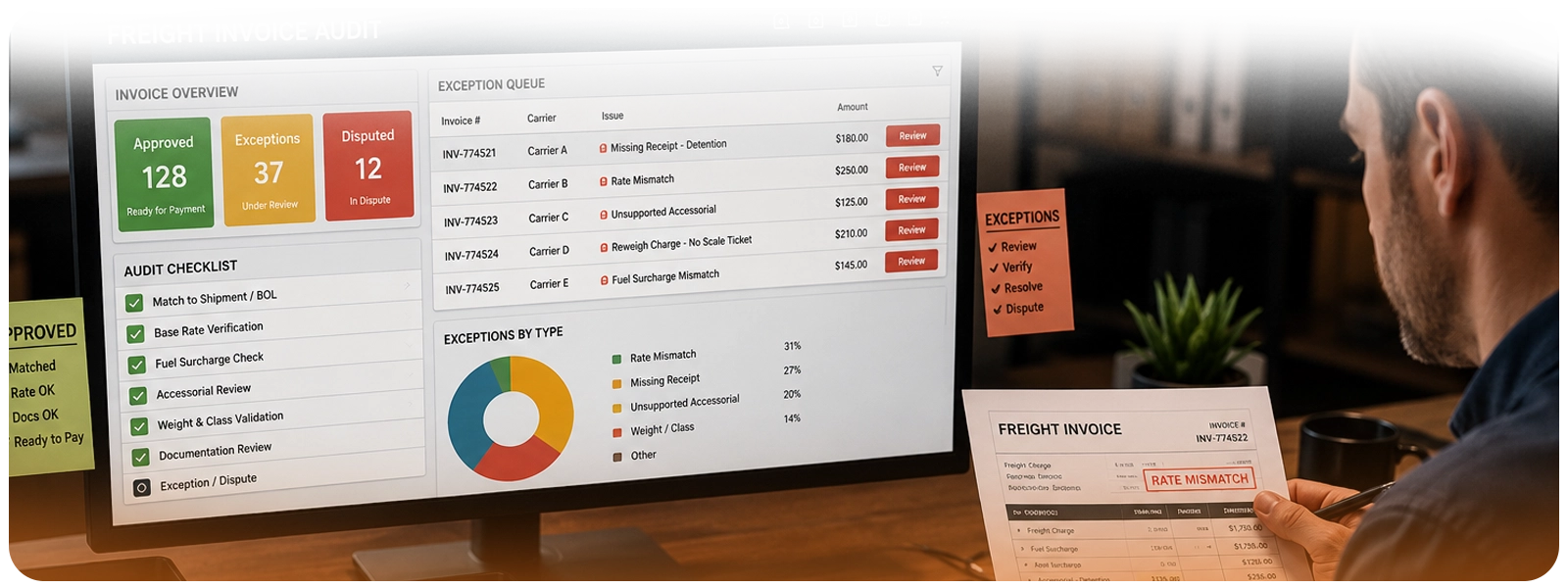
A reliable audit begins by collecting invoices through one controlled process rather than allowing them to remain scattered across inboxes, portals, and departments.
Each invoice is then matched to the correct shipment using the load number, bill of lading, purchase order, or other reference. The reviewer confirms the base rate, fuel calculation, weight, freight class, origin, destination, and service level.
Accessorials require additional review. Detention should have valid arrival and departure times. Lumper charges should include receipts. Reweighs and reclassifications should have supporting measurements or carrier records.
Invoices that match the agreed terms can move forward for payment. Questionable charges enter an exception queue for manual review or dispute.
Carriers such as FedEx provide formal processes for requesting invoice adjustments, disputes, rebills, and pricing reviews, showing why questionable charges should be investigated before payment rather than accepted automatically.
The final step is tracking recurring errors by carrier, facility, lane, or charge type so the shipper can prevent the same cost from returning.
What a 2%–5% Recovery Looks Like in Real Numbers
Consider a shipper spending $200,000 per month on truckload and LTL transportation.
An illustrative monthly audit may identify:
The calculation is:
$4,800 ÷ $200,000 = 2.4% of monthly freight spend
If the same pattern continued for one year, the identified amount would reach $57,600.
At different spending levels, the potential impact becomes clearer:
These are illustrative calculations, not guaranteed savings. Actual recovery depends on invoice accuracy, carrier agreements, available documentation, and how much auditing the shipper already performs.
When Freight Invoice Audit Services Pay Off
Freight invoice auditing becomes more valuable as shipment volume, carrier count, and billing complexity increase.
A small shipper with a few predictable invoices may manage the process manually. A company handling hundreds of monthly invoices across multiple carriers, modes, facilities, and rate agreements faces a much higher risk of duplicate payments, unsupported accessorials, and incorrect billing adjustments.
The value of an audit is not limited to recovering money. It also reveals why costs are occurring. Repeated detention may point to a facility problem. Frequent reclassification may reveal incorrect product data. Recurring carrier corrections may show that contract terms are not being applied consistently.
Shippers should begin by auditing a representative sample of recent invoices and measuring the errors as a percentage of total freight spend.
FreightBridge BPO can support invoice review, document matching, exception handling, and routine freight-payment preparation.